Hotline Miami: driving soundtrack, neon-drenched visuals, sickening violence and one of the most clever narratives ever put into a video game.
A little context might be in order; I'm not a particularly big fan of violence in most media, but I don't have any particular issues with it, bar in a few particular circumstances. With this in mind I came in to
Hotline Miami unsure as to what my reaction would be; the soundtrack and art style appealed to me greatly in the trailers and reviews, while the violence left me unsettled. These reactions did not change much, but the strong narrative caught me by surprise, no one seemed to mention it in initial reviews beyond that it was abstract, or hard to follow, which to me seemed one of the few criticisms the game received. The narrative is certainly abstract, but what is going on on the screen is not the only narrative; there is something going on between the game and you as the player, something I believe is directly referenced and addressed throughout the game.

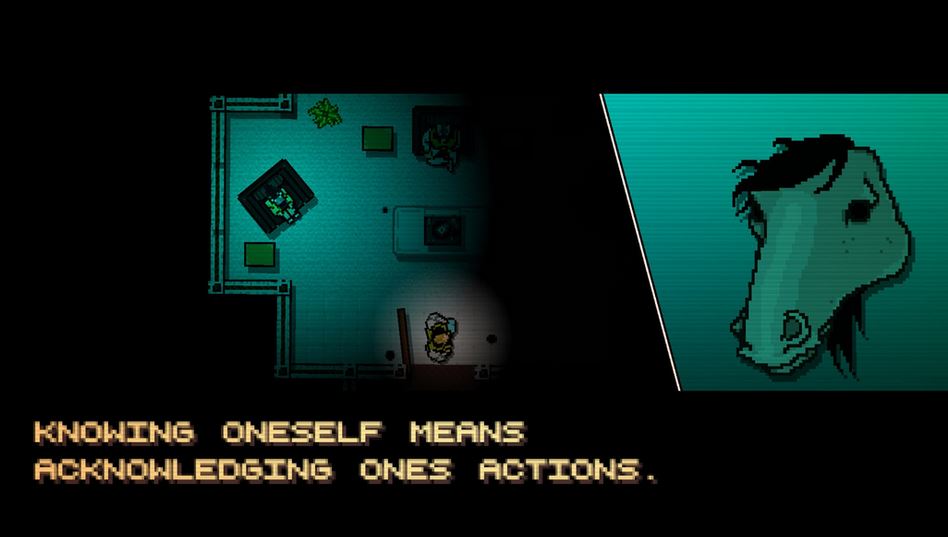
That line in the image above is not directed at "Jacket" as I see it, but rather at you as the player; it directly questions your motives for murdering the people the game tells you to murder, the game certainly doesn't give you much context (or any, in the beginning). It questions why you are enjoying what is essentially a spree of hyper-violence; and I love it for that. Games have, for a long time, reveled in pure game play, eschewing narratives entirely due to a perception that they are not required. Everyone knows that the little space ship in
Space Invaders is the 'good guy', the aliens at the top 'bad guys' and such was the state of it; shoot everything that moves, get points, move on.
Spec Ops: The Line and
Hotline Miami represent a newly emerging attitude towards the violence we engage in for entertainment, one that criticises the way we blindly accept our motives and are perfectly OK with everything that happens afterwards so long as it is justified.
Spec Ops is of course criticising warfare in general and is at least partially based on or inspired by
Heart of Darkness, and while I think both games make their criticisms in different and effective ways there is one particular element that separates the two: the element of choice.
Spec Ops' most infamous scene (the white phosphorus sequence) is a false choice; in order to complete the objective and to save civilians (or so you are told) you have to use white phosphorus; there is no other option; something that leaves the reveal afterward feeling a little hollow.
Hotline Miami on the other hand nails it with clever design decisions. After introducing the game's mechanics in a most unsettling manner (establishing a baseline for the impact of the violence, something also done in
Spec Ops) before disguising this impact under something else; a purpose (again, something both games do), in the case of
Hotline Miami the first, and only objective you receive is to take a briefcase. After you talk with three masked figures in a surreal sequence there is one, essential part to Hotline Miami that makes the subsequent questioning of your morals mean something; you begin in your house. A fairly innocuous detail on the surface, but one with greater implications: you never
needed to kill these people, you
chose to.
You left the house.
You continued to leave the house on future occasions.
You killed these people, because just staying in the apartment wasn't enough for you, because you wanted game play, and that small distinction makes
Hotline Miami what it is, because it makes you
want to kill these people, before it ever questioned you for doing so, through a fantastic array of reward systems.
Firstly the music is rewarding you as you play; thumping 80s synth and electronica driving you through each level. On top of this is a scoring system that rewards fast gameplay with combos and greater violence netting higher scores, flashing lights in bright colours and large numbers highlighting recent victims. Because of this emphasis on fast, twitchy game play your attention is never focused on what it is you're actually doing, and acts that made me a little sick to my stomach at times go by almost unnoticed in a frenzy of top-down, tightly executed combat.

Then the level is over and the reward systems aren't there anymore; the music has stopped and been replaced by an eerie drone and the only thing left to do is find your way out via the way you came, wading through the gore you so recently created and all of a sudden that sickening feeling, established in the tutorial, returns, you see what you've done and you acknowledge that at the time you were enjoying yourself. Through this the game brilliantly manipulates your preconceptions of reward systems and your expectation of associated moral justification to create an unsettling statement on the violence we so readily consume, even if it is, as the game loves to remind us, just a game; are we really OK with just accepting that we'll commit horrible acts of violence just because we are told to, and does it even matter if the violence
is justified?
Hotline Miami is more than just an excellent soundtrack and fantastic game play, it's a game that's not afraid to question you as the player, to question your motives, but also why you might look for them; not afraid to create a message about violence in games (and perhaps in media in general) while being itself an extremely violent game. A master class in creating meaningful reward systems and linking game play to story beats,
Hotline Miami is an absolute masterstroke.