Showing posts with label Videogames. Show all posts

Friday, 26 February 2016

Who we play as - Videogames, the protagonist and the player


[Edit] The old video is pretty awful, and although I had fun with it I don't really want it to represent my work, the link still works, but the video is unlisted and has now been replaced with a new one that's a lot more serious and now includes relevant gameplay. I think the improvement between the two is pretty tangible, but it's still not perfect and I'd love feedback. The new video is embedded below. [End Edit]


I made a YouTube video, this is the script I was originally going of, I changed things a bit in the resultant video - see the video here or in the embedded video below and give me some feedback if you can, I'd like to know if the style of comedy I'm going for is interesting to anyone. Just don't complain about the Cicadas. I know about the cicadas.


I recently started for the second time to play Fallout 3. The first time I tried to play as a male avatar, one that looked like me. Within an hour I gave up on that first play through. On my second attempt however I made a female avatar and have probably sunk around 20 hours into the game with this character thus far, despite not being particularly partial to open world games. At first I wasn’t sure why I seemed to be instantly more invested with a female avatar, the Jennifer Hale is a better voice actor argument doesn’t work for a silent protagonist, but I think at least part of the reason lies in Dreamfall: The Longest Journey. In Dreamfall you play as Zoe, and Zoe was the first playable character I truly felt invested in within a video game, in some ways I think that investment carried over into other female protagonists.

Thursday, 17 September 2015

5 Scientific reasons "Clickbait" is making you less intelligent


 1) They're spoon feeding you. Numbered lists as commonly used by clickbait articles break down information into short and easily digestible chunks; acclimatising your mind to shorter sentences, smaller words and creating an environment that requires little active critical thought. Essentially the abundance of clickbait and the lack of longer form articles leaves you with a lower tolerance for articles that require more attention.

2) The content doesn't matter. The headline, photo and ads are the real meat of a clickbait article; the article is only there to provide an excuse to exploit their audience and deliver them too advertisers. This isn't true of all cases; sometimes an ordinary article will be named in a clickbait fashion to garner additional attention, but true clickbait is generally what makes up for gaps in longer-form content or a lack of income.

3) It's all the same. Clickbait follows a pretty well established formula for getting views; exploit fears (either to make you scared of something you wouldn't have been or to down play common fears) use numbers (numbers break down information; exploit a fear of missing out on information and gives the audience an idea of how long the article is) and challenge or be seen to oppose dominant ideas (Health professionals hate this simple trick, 10 reasons why the Beatles weren't a good band etc.).

Again, going back to the second point, the content does not matter, your emotional reaction is what they exploit; regardless of how you react to the information it's the strength of the reaction that makes you click, either to see your view justified or to feel righteously indignant. Click on the scrappy image I made below to get an idea of the general structure a lot of clickbait follows.


4) Outrage and controversy sells. People like Nicole Arbour aren't just bumbling into stupid controversy accidentally; it's calculated and considered. Her comments and views are nasty, oppositional and attack one particular group for no other reason than to advance a healthy-centric notion of superiority based on ones size. By dividing opinion and deliberately sparking controversy she created for herself a great tool of promotion; people argued with eachother over the video; giving it further views.

Of course this isn't only done for what I personally think are negative purposes; Anita Sarkeesian went from broader criticism of movies and TV shows to focusing on "Tropes vs. Women in videogames". I'm a big feminist and while I don't always totally agree with everything Sarkeesian says her overall perspective on videogame tropes as arising out of patriarchal norms is scathing and broadly speaking a very important message. To push her (and mine, for the sake of further revealing obvious bias on my part) views further she exploits the defensive nature of many people that play games to generate, maintain and utilise the opposition she gets. While her critics might argue that, for example, titling a video "25 invisible benefits of gaming while male" is an attempt at a cash grab; I would argue that it's more about pushing awareness further. So, to be clear, not all clickbait is inherently bad, but you've got to critically look at why something is being pushed in that form.

5) It's probably not true. Clickbait frequently describes it's content as scientific, but rarely has any basis in fact. You might have noticed by now, but I'm talking out of my arse at the moment. But none of that matters for websites; it's far more profitable to publish an inaccurate article and apologise later than to publish an accurate one because the site has already garnered its revenue, and people are far more likely to click on something that has some supposed value to it.

So. This post really was a bit of an experiment. One was whether using clickbait techniques in naming would garner a higher view count. Another was to see how people react to deliberately exploitative and false content, there is no scientific proof of anything that I'm saying (or at least nothing I've seen or based arguments off of). I put a little more effort into this than I might have were it an actual clickbait article and I didn't want the thing to be really awful just for the sake of experimenting with form and content, but this isn't going to be a regular thing.

Thursday, 18 June 2015

In Praise Of: Hotline Miami


Hotline Miami: driving soundtrack, neon-drenched visuals, sickening violence and one of the most clever narratives ever put into a video game.

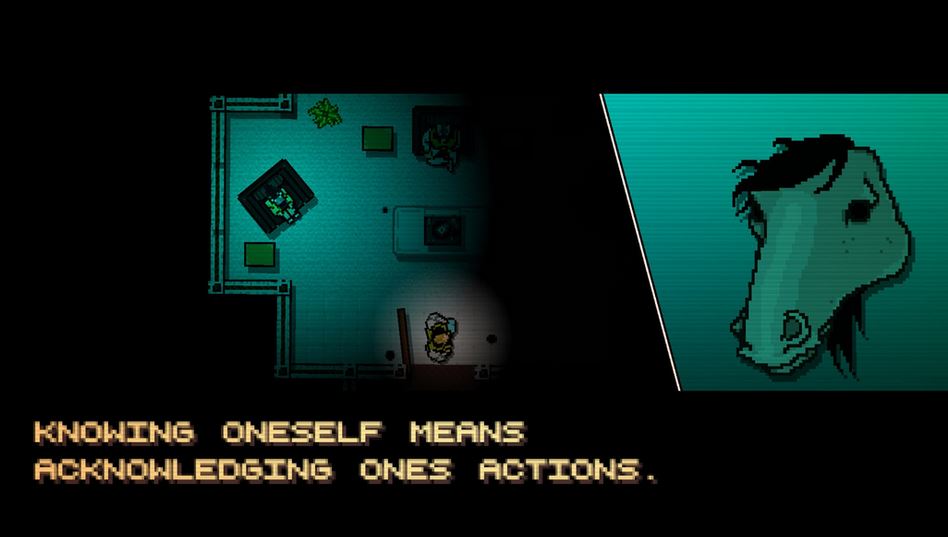
A little context might be in order; I'm not a particularly big fan of violence in most media, but I don't have any particular issues with it, bar in a few particular circumstances. With this in mind I came in to Hotline Miami unsure as to what my reaction would be; the soundtrack and art style appealed to me greatly in the trailers and reviews, while the violence left me unsettled. These reactions did not change much, but the strong narrative caught me by surprise, no one seemed to mention it in initial reviews beyond that it was abstract, or hard to follow, which to me seemed one of the few criticisms the game received. The narrative is certainly abstract, but what is going on on the screen is not the only narrative; there is something going on between the game and you as the player, something I believe is directly referenced and addressed throughout the game.


That line in the image above is not directed at "Jacket" as I see it, but rather at you as the player; it directly questions your motives for murdering the people the game tells you to murder, the game certainly doesn't give you much context (or any, in the beginning). It questions why you are enjoying what is essentially a spree of hyper-violence; and I love it for that. Games have, for a long time, reveled in pure game play, eschewing narratives entirely due to a perception that they are not required. Everyone knows that the little space ship in Space Invaders is the 'good guy', the aliens at the top 'bad guys' and such was the state of it; shoot everything that moves, get points, move on.

Spec Ops: The Line and Hotline Miami represent a newly emerging attitude towards the violence we engage in for entertainment, one that criticises the way we blindly accept our motives and are perfectly OK with everything that happens afterwards so long as it is justified. Spec Ops is of course criticising warfare in general and is at least partially based on or inspired by Heart of Darkness, and while I think both games make their criticisms in different and effective ways there is one particular element that separates the two: the element of choice. Spec Ops' most infamous scene (the white phosphorus sequence) is a false choice; in order to complete the objective and to save civilians (or so you are told) you have to use white phosphorus; there is no other option; something that leaves the reveal afterward feeling a little hollow. Hotline Miami on the other hand nails it with clever design decisions. After introducing the game's mechanics in a most unsettling manner (establishing a baseline for the impact of the violence, something also done in Spec Ops) before disguising this impact under something else; a purpose (again, something both games do), in the case of Hotline Miami the first, and only objective you receive is to take a briefcase. After you talk with three masked figures in a surreal sequence there is one, essential part to Hotline Miami that makes the subsequent questioning of your morals mean something; you begin in your house. A fairly innocuous detail on the surface, but one with greater implications: you never needed to kill these people, you chose to. You left the house. You continued to leave the house on future occasions. You killed these people, because just staying in the apartment wasn't enough for you, because you wanted game play, and that small distinction makes Hotline Miami what it is, because it makes you want to kill these people, before it ever questioned you for doing so, through a fantastic array of reward systems.


Firstly the music is rewarding you as you play; thumping 80s synth and electronica driving you through each level. On top of this is a scoring system that rewards fast gameplay with combos and greater violence netting higher scores, flashing lights in bright colours and large numbers highlighting recent victims. Because of this emphasis on fast, twitchy game play your attention is never focused on what it is you're actually doing, and acts that made me a little sick to my stomach at times go by almost unnoticed in a frenzy of top-down, tightly executed combat.


Then the level is over and the reward systems aren't there anymore; the music has stopped and been replaced by an eerie drone  and the only thing left to do is find your way out via the way you came, wading through the gore you so recently created and all of a sudden that sickening feeling, established in the tutorial, returns, you see what you've done and you acknowledge that at the time you were enjoying yourself. Through this the game brilliantly manipulates your preconceptions of reward systems and your expectation of associated moral justification to create an unsettling statement on the violence we so readily consume, even if it is, as the game loves to remind us, just a game; are we really OK with just accepting that we'll commit horrible acts of violence just because we are told to, and does it even matter if the violence is justified?


Hotline Miami is more than just an excellent soundtrack and fantastic game play, it's a game that's not afraid to question you as the player, to question your motives, but also why you might look for them; not afraid to create a message about violence in games (and perhaps in media in general) while being itself an extremely violent game. A master class in creating meaningful reward systems and linking game play to story beats, Hotline Miami is an absolute masterstroke.

Tuesday, 16 June 2015

Video Game Details: Bioshock Infinite's most dangerous locale


Firstly a quick message: As the second post to this blog, I thought I'd make the exact opposite to my first post; as well as give a bit of an idea how I will approach posts in future. Grinding My Gears in my mind will be an occasional series with writing about things in entertainment and media that are irritating me, typically with a slightly more serious bent. Video Game Details will consist of shorter, more silly posts spotlighting details in Game design and their brilliance or stupidity (or both in the right situations). I've got more plans for other regular posts which I'll reveal as I go, if you've got any recommendations or criticisms leave a comment, I'll read all of them.

Bioshock Infinite's Columbia is pretty heavy on symbolism and arguably the biggest, bar the lighthouses that feature prominently in the final sequence, is Baptism (and related concepts of course). As such water features quite prominently, most noticeable in the opening sequence: water covers the floors, offering reflections of the candles and stained glass windows that make up the area. The first dream like moment was induced by near drowning during a baptism, but in reality you'd find it hard to make it that far alive.
What am I talking about? The fact you'd likely die during the initial ascent? The fact that any town quite as paranoid about an intruder as clearly branded as Booker would have a guard when you first arrive at the Church like entrance? No, but both of those would be far more legitimate reasons than the one I'll discuss (and far to legitimate for these posts). No, I'm talking about the poor design of the area's plumbing and the staircase that would likely leave you in a broken pile at the bottom.
Sure, it might look nice, having an endless stream of water running down a stone staircase lit only by the occasional window and a quantity of candles significantly larger than anyone could realistically replace each day, but that is one hell of a dangerous staircase if ever I saw one.
Notice that this system isn't only dangerous for you, new visitors or the constant rotation of candle-replacers that must inevitably populate this church, but also for the priest/ official welcome. He is standing in robes that are wet, constrictive and likely heavy and is expected to walk down these poorly lit stone steps with a constant stream of water running down them? Perhaps this is Father Comstock's notion for population control, or an underpaid architect's petty revenge, but truly this pretty little introduction would cause more than a few issues in the real world.