Monday, 17 August 2015

Episode by episode | Avatar: The Last Airbender s1 e1


Avatar: The Last Airbender is, in this guy’s humble opinion, the single greatest series aimed (primarily) at kids to ever grace my TV (or computer) screen. With some of the best characters, themes, fight sequences and morality stories I’ve personally come across, my love for this show is perhaps justified, but somehow re-watching the series again as an adult for the seventh time (I think, give or take a viewing) is a little hard to justify to myself. So I thought I should really look into why I love it so much, on an episode by episode basis. Much and more has been written about ATLA and subsequently TLOK but hopefully someone is interested in reading up on what is without doubt (again, in my eyes) the most ambitious animated series ever made (It would be very hard to compare ATLA to anime, the styles are very different so take that with a pinch of salt). So, here begins an episode by episode review of a series that isn’t particularly relevant anymore, that everyone has likely watched already. Yep, this’ll rake in the page views for sure.


The opening for the first episode introduces the world and sets the stage for the show as a whole quite well; establishing the avatar as the protector of the balance between the four elemental nations (Earth, Fire, Water and Air) and reveals a little of the scope and length of the war, where after 100 years the Fire nation are nearing victory. Finally the introduction ends with the narrator (whom you know to be Katara from the rest of the episode) stating that she still has hope that the Avatar will return and save the world. Pretty great set up if you ask me and boy do they ever deliver on the premise. 

Enter the episode itself and we are quickly introduced to Sokka and Katara and what I’ll put down as the first moral lesson; while Sokka is attempting to spear a fish Katara catches one herself with waterbending and Sokka dismisses her abilities of hand, while doing so allowing the fish to escape and soaking himself in water; a nice little story warning of the pitfalls of judging someone’s abilities without allowing them to actually use them. From there we are introduced to a variety of characters; Aang who emerges from an iceberg with glowing eyes and tattoos, his flying bison Appa (who is our first taste of the menagerie of wonderfully strange animals throughout the series), and Zuko and Iroh the banished prince and his uncle who are hunting for the avatar. 

These, as we are told, are apparently penguins
Running down these characters the show instantly reveals a lot of their character traits and motivations; Katara who is unhappy with being looked down upon because of her gender and expected role in the tribe (wonderfully done with a natural introduction as to how her views have come about, demonstrating the disbelief that Sokka has regarding her ability to catch a fish as that’s not the role she is expected to play, Sokka is holding the spear and is at the head of the boat filling said role), Sokka who just doesn’t want to have anything to do with ‘magic water’, airbenders or other things that don’t make sense, Aang who is cheerful and fun-loving despite the responsibilities and pressures of a world he doesn’t fully understand (both because of his young age and his time in the iceberg), Zuko who is fuelled by anger and a vague allusion to his honour (at this point unexplained) and finally Iroh who loves tea.


The visual language introduced is fantastic as well; with three of the four elements represented via the costumes of the introduced characters; black, gold and red for the fire nation, white, purple and blue for the water tribes and orange, yellow and blue for the air nomads (clearly taking quite heavy influence from the traditional robes of Buddhist monks, just as the water tribe outfits draw upon the Inuit’s heavy furs).


Visually the show is overflowing with style and musically it does so as well with a great score made up mostly of tribal drums and percussion, unusual stringed instruments and cymbal swells; making for an understated but perfectly fitting musical score that really helps set the mood and atmosphere for each scene. The end credits were always a bitter-sweet memory for me as it represented the end of my favourite show, but I also loved the music and hearing it again after ending on a bit of a cliff hanger is wonderful and incredibly nostalgic for me as I’m sure it is for any of you who may have watched it.


Overall this episode is a great introduction into a detailed, vibrant and joyous world that walks the line between making the content age appropriate for younger viewers and also dark and deep enough for older viewers in a way nothing else I’ve seen has managed. With fantastic art, music, characters and direction this episode does a really good job of introducing everything you really need to know without veering into exposition; something much easier said than done.
 
Aaand a post script: I didn't discuss the story in it's entirety as some may not have watched it. If that's you either watch it or ignore these posts! In all future posts I will fully discuss the plot and even though the show is not ruined without the element of the unknown; it's not made any stronger for it's absence, so don't spoil it for yourself!

Monday, 27 July 2015

In Praise Of: Kill La Kill


To explain why Kill La Kill was such a pleasant surprise to me requires a little back story. There were two anime series I seemed to hear everyone talking about; Sword Art Online (from now on abbreviated as SAO) and Kill La Kill. SAO was appealing, it had a solid concept and I thought the buzz surrounding it would be a positive sign. I went in with moderate, but somewhat restrained expectations. It started with a few decent references to game culture and an obvious disconnect with the psyche of a player from the mindset one would employ in a real life scenario and I thought it would carry on like that. Unfortunately it devolved further and further into a mess of poorly constructed reasons for fan service. I stopped watching after the end of the second arc and didn't like more than a third of the episodes in the end, which I thought was a massive shame given the potential they had going for them from the beginning. The two words I would describe SAO with is squandered potential.

Sorry SAO fans, it's not my thing.

And then I watched Kill La Kill (which was of course the other series people were talking about), now with low expectations; after all, I'm not a fan of fan-service, not massively into anime in general and wasn't sold on a show in which the main two characters (kind of, Mako and Satsuki are of equal importance really) are a school girl and her skimpy outfit.

So I have an issue with fan service. Aaaand I like Kill La Kill? Alright, let me explain. Kill La Kill takes just about everything I don't like about anime in general, exaggerates it, flips it on its head and then exaggerates it some more. But of course I've got to talk about the fan service first. There is a lot of it. A LOT.


Roughly the first three or so episodes felt a touch out of balance and the excessive fan service initially felt a little on the nose and I was worried it would get worse (much like SAO did). And it did. But something changed, all of a sudden the fan service was infused with a great sense of humour; the discussions between Senketsu and Ryuko were fantastic (as was the dialogue in general) and the raw visual style of the show started to sink its hooks into me. The biggest change in my perception of the fan service was ultimately that the framing wasn't dis-empowering for the subject of the fan service in question; indeed it was actually empowering.

Although the transformation sequence is a touch too much in my eyes, especially so given how often it plays.

Rather than perpetuating a trope I seem to see a lot in anime; that of weak female characters that only serve to fill a harem for the male lead who is invariably a psychopath to boot (looking at you SAO) Kill La Kill went out of its way to flip the convention of fan service on its head; making it equal opportunity by mid way through the series; having its purpose as to accentuate humour (rather than exclusively keep a male audience interested as it often seems to be the case) to the point that I felt the same way about the male nudity as I did the female nudity. That is to say it wasn't linked even a bit to sexual attraction as I initially had assumed was the only purpose of such excessive nudity. (At least that was my reaction, the internet at large seems to disagree with me on that front).


And the characters. So damn good. Too often there is the hero, the villain and everyone else. While the hero and villain get fleshed out characters, back stories and appearances, everyone else tends to look or act pretty much the same way. This is certainly not true of Kill La Kill. Ryuko quickly establishes herself as someone who doesn't take anything from anybody, has no respect and more importantly no fear for the oppression that presides over the entirety of Honno city at the hands of Honnoji accademy. Mako subsequently also establishes herself as almost the complete opposite of Ryuko and strikes a friendship with her based on something other than merely similarities. Homeroom teachers have alter egos with glowing purple nipples, a guy with a Mohawk has an ingrained hatred of clothes and minor characters all have their own appearances and character traits.


The music, character design, backgrounds and fight choreography all take in a variety of of styles and forms yet feel cohesive as a whole and elements are repeated to form a language entirely its own when it comes to a pursuit of comedy (see the Mako scenes). Above all else it oozes style, from the colour palettes of different characters (see Satsuki's white, blue and gold next to Ryuko's black, red and navy blue clothing) to the wonderfully over the top backgrounds, chunky fonts that take up nearly the whole screen in a violent red and Ryuko herself (Mako too) who so wonderfully subvert and defy the standard roles women (within the context of fictional narratives) are usually expected or desired to play. It's so crammed full of jokes, fights, dialogue and characters without a single moment of filler (bar one brilliant joke that mocks the notion of catch up episodes in roughly a minute) that I legitimately felt spoiled watching it.


In closing I'd like to acknowledge one thing that is a bit of an issue with the series, and those are the scenes between Satsuki and her mother which go much too far in my eyes, as do the transformation sequences, these, in my eyes at least, are the only moments where they seem to focus purely on fan-service to the detriment of the story. But that's the show's only flaw, and when the series as a whole is packed with so much humour, style and character what a small flaw it seems.

Kill La Kill, I salute you, may we see your like again.

Edit: If you've come this far you might be interested in another piece of writing I did on Kill La Kill, it's currently my featured article. I also made a video on the same topic from that blog post, it's embedded below. Cheers - Tim.

Wednesday, 24 June 2015

Video Game Details: Gunpoint's brilliant animation


Oh boy, Gunpoint. I'll likely have an "In Praise Of:" post for this game at some point because it's utterly brilliant in it's entirety. Any individual detail merits a post, but I'm going to talk only about one. While the art style, music and writing are all reasons I bought the game, one of the biggest deciding factors was a really small detail, one that exemplifies in my view the style of humour Gunpoint has going for it: the falling animation.


In Gunpoint you jump by holding the mouse button and charge the strength of the jump (up to a point) for as long as you hold the M1 key down. When you release you jump, following the parabolic arc represented (in the above image) by the dots on screen.


Do you see the playable character (Richard Conway) there? He just flung himself from a building. Now, at the apex of his arc, he is in the superman pose. Brilliant. Are you in love yet? No? Take a gander down here then.


See the way that little trench coat is flapping upwards with the air resistance? Isn't that just beautiful. Still not convinced? Well, this isn't the punchline quite yet.


*plaf* That's about the best way I can describe the (wonderful) sound you make as you fall flat on your face. A core mechanic in the game (that is that you take no fall damage, as well as your ability to perform massive jumps) is explained away by Conway possessing a special pair of trousers that have some sort of springs in them. Then to test them he jumps out his apartment window and he is flat on his face, just like in the image above. The game wonderfully makes fun of it's silly explanation of core mechanics and creates a fantastic visual gag at the same time, and this tiny detail is just one of the reasons I think Gunpoint is as good, if not better than, some of the indie heavyweights (for example Super Meat Boy, Hotline Miami, FTL) and one of my all time favourite games in general.

Tremendously fun, it remains the only game I've ever wished I paid more for than I did (I bought it during a steam sale). And if I had to pick the one quality amongst so many brilliant individual elements that made me fall in love with the game; this tiny animation would be it.

Tuesday, 23 June 2015

Between The Lines: the 13 1/2 lives of Captain Bluebear


"People usually start life by being born." With that line, the book begins; an odd line to begin on and a wonderful introduction to the pure, joyous absurdity that follows. Stylistically similar to Douglas Adams' The Hitchhiker's guide to the galaxy the book, written by Walter Moers, follows the life (or rather the first 13 and a half lives) of Bluebear; from his discovery by the minipirates that found him floating in a walnut shell towards the edge of the greatest whirlpool to ever exist to his tenure as the greatest living congladiator and the magnificent lies that he told to claim this title. Told in the past tense, but with only the knowledge of the time, bar occasional dips into the encyclopedia in Bluebears head, the novel is written in first person and delights in the most elaborate and fantastical adventures one could ever imagine.


More than just a fantastical children's tale the book combines metaphors (grand and small), morality tales and adult ideas (although well hidden ones that likely no child under 12 would pick up on) with wonderful illustrations (also by Walter Moers) and a hefty size (just over 700 pages). Despite it's size its incredibly easy to read, with great use of different fonts, pictures, diagrams and visual emphasis of the likes of Onomatopoeia with various formatting choices, letter spacing and page by page build ups of size and font. Essentially the feeling created is that of a drawing, even when it's merely text, which makes sense as Moers is also a well reputed cartoonist.

The reason I really love this book though, although inclusive of all these details, are the clever metaphors for developmental milestones and real world feelings to bizarre happenings in a fictional world; be it the way friends drift in and out of your life, the way you only suddenly seem to notice your aging or ways in which certain relationships can be toxic and harmful while others are healthy and fulfilling, to name but a few of the more obvious ones, but both of the subsequent readings after the first revealed more parallels and moral messages that I hadn't noticed on first reading, a sign of a great book if ever I saw (read) one. There's not much more to say without heading into spoiler territory, so I urge you to pick this book up for yourself and give it a read if you haven't already, it's tremendously enjoyable (or at least I imagine it to be) for people of any age.

Thursday, 18 June 2015

In Praise Of: Hotline Miami


Hotline Miami: driving soundtrack, neon-drenched visuals, sickening violence and one of the most clever narratives ever put into a video game.

A little context might be in order; I'm not a particularly big fan of violence in most media, but I don't have any particular issues with it, bar in a few particular circumstances. With this in mind I came in to Hotline Miami unsure as to what my reaction would be; the soundtrack and art style appealed to me greatly in the trailers and reviews, while the violence left me unsettled. These reactions did not change much, but the strong narrative caught me by surprise, no one seemed to mention it in initial reviews beyond that it was abstract, or hard to follow, which to me seemed one of the few criticisms the game received. The narrative is certainly abstract, but what is going on on the screen is not the only narrative; there is something going on between the game and you as the player, something I believe is directly referenced and addressed throughout the game.


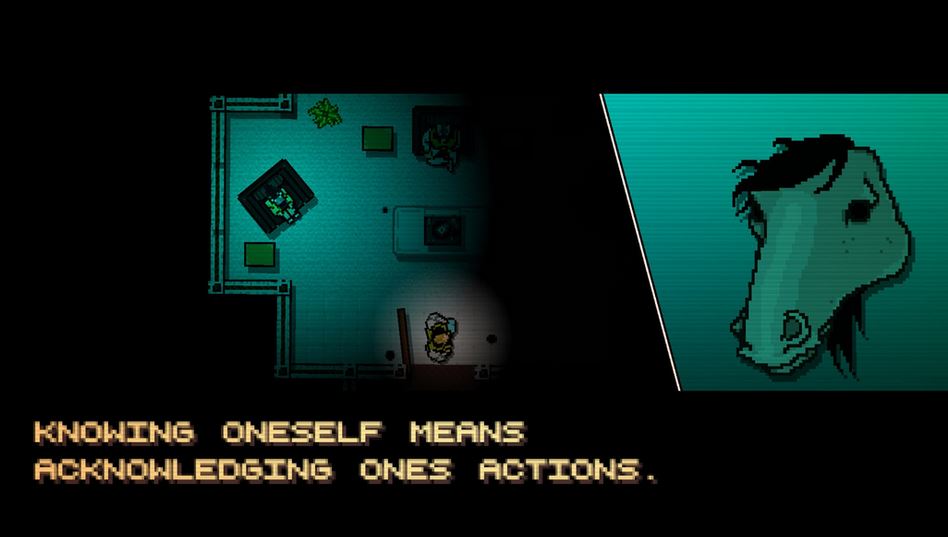
That line in the image above is not directed at "Jacket" as I see it, but rather at you as the player; it directly questions your motives for murdering the people the game tells you to murder, the game certainly doesn't give you much context (or any, in the beginning). It questions why you are enjoying what is essentially a spree of hyper-violence; and I love it for that. Games have, for a long time, reveled in pure game play, eschewing narratives entirely due to a perception that they are not required. Everyone knows that the little space ship in Space Invaders is the 'good guy', the aliens at the top 'bad guys' and such was the state of it; shoot everything that moves, get points, move on.

Spec Ops: The Line and Hotline Miami represent a newly emerging attitude towards the violence we engage in for entertainment, one that criticises the way we blindly accept our motives and are perfectly OK with everything that happens afterwards so long as it is justified. Spec Ops is of course criticising warfare in general and is at least partially based on or inspired by Heart of Darkness, and while I think both games make their criticisms in different and effective ways there is one particular element that separates the two: the element of choice. Spec Ops' most infamous scene (the white phosphorus sequence) is a false choice; in order to complete the objective and to save civilians (or so you are told) you have to use white phosphorus; there is no other option; something that leaves the reveal afterward feeling a little hollow. Hotline Miami on the other hand nails it with clever design decisions. After introducing the game's mechanics in a most unsettling manner (establishing a baseline for the impact of the violence, something also done in Spec Ops) before disguising this impact under something else; a purpose (again, something both games do), in the case of Hotline Miami the first, and only objective you receive is to take a briefcase. After you talk with three masked figures in a surreal sequence there is one, essential part to Hotline Miami that makes the subsequent questioning of your morals mean something; you begin in your house. A fairly innocuous detail on the surface, but one with greater implications: you never needed to kill these people, you chose to. You left the house. You continued to leave the house on future occasions. You killed these people, because just staying in the apartment wasn't enough for you, because you wanted game play, and that small distinction makes Hotline Miami what it is, because it makes you want to kill these people, before it ever questioned you for doing so, through a fantastic array of reward systems.


Firstly the music is rewarding you as you play; thumping 80s synth and electronica driving you through each level. On top of this is a scoring system that rewards fast gameplay with combos and greater violence netting higher scores, flashing lights in bright colours and large numbers highlighting recent victims. Because of this emphasis on fast, twitchy game play your attention is never focused on what it is you're actually doing, and acts that made me a little sick to my stomach at times go by almost unnoticed in a frenzy of top-down, tightly executed combat.


Then the level is over and the reward systems aren't there anymore; the music has stopped and been replaced by an eerie drone  and the only thing left to do is find your way out via the way you came, wading through the gore you so recently created and all of a sudden that sickening feeling, established in the tutorial, returns, you see what you've done and you acknowledge that at the time you were enjoying yourself. Through this the game brilliantly manipulates your preconceptions of reward systems and your expectation of associated moral justification to create an unsettling statement on the violence we so readily consume, even if it is, as the game loves to remind us, just a game; are we really OK with just accepting that we'll commit horrible acts of violence just because we are told to, and does it even matter if the violence is justified?


Hotline Miami is more than just an excellent soundtrack and fantastic game play, it's a game that's not afraid to question you as the player, to question your motives, but also why you might look for them; not afraid to create a message about violence in games (and perhaps in media in general) while being itself an extremely violent game. A master class in creating meaningful reward systems and linking game play to story beats, Hotline Miami is an absolute masterstroke.